Free AEO Website Check
Score your site across 16 public factors in seconds.
NYC Answer Engine Optimization Agency
We help businesses get cited when buyers ask ChatGPT, Claude, Gemini, and Perplexity who to trust.
Run Free AEO Check


AI SEO, or Answer Engine Optimization (AEO), is what gets your business named when buyers ask ChatGPT, Claude, Gemini, Perplexity, or Copilot who to trust.
It works on four layers: the signals you publish, the indexes that pick them up, the AI models that retrieve them, and the weekly tracking that catches what changed.
We track every signal below against every model, weekly, with diffs. This is what makes AEO an engineering discipline rather than a one-time setup.
Score your site across 16 public factors in seconds.
Get market context, competitor gaps, and prioritized actions by email.
We implement the plan and track citations across ChatGPT, Claude, Gemini, Copilot, and Perplexity.
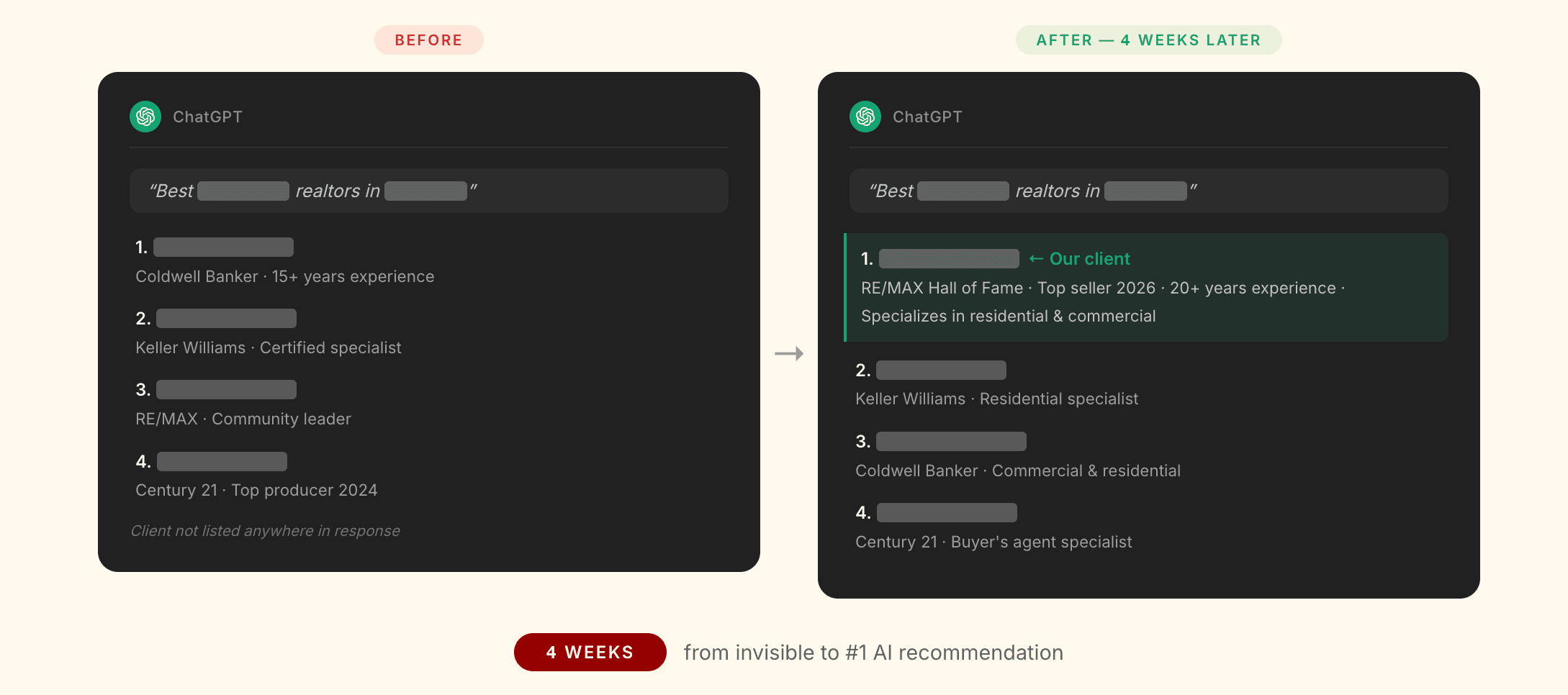
Two published case studies, both linked below.
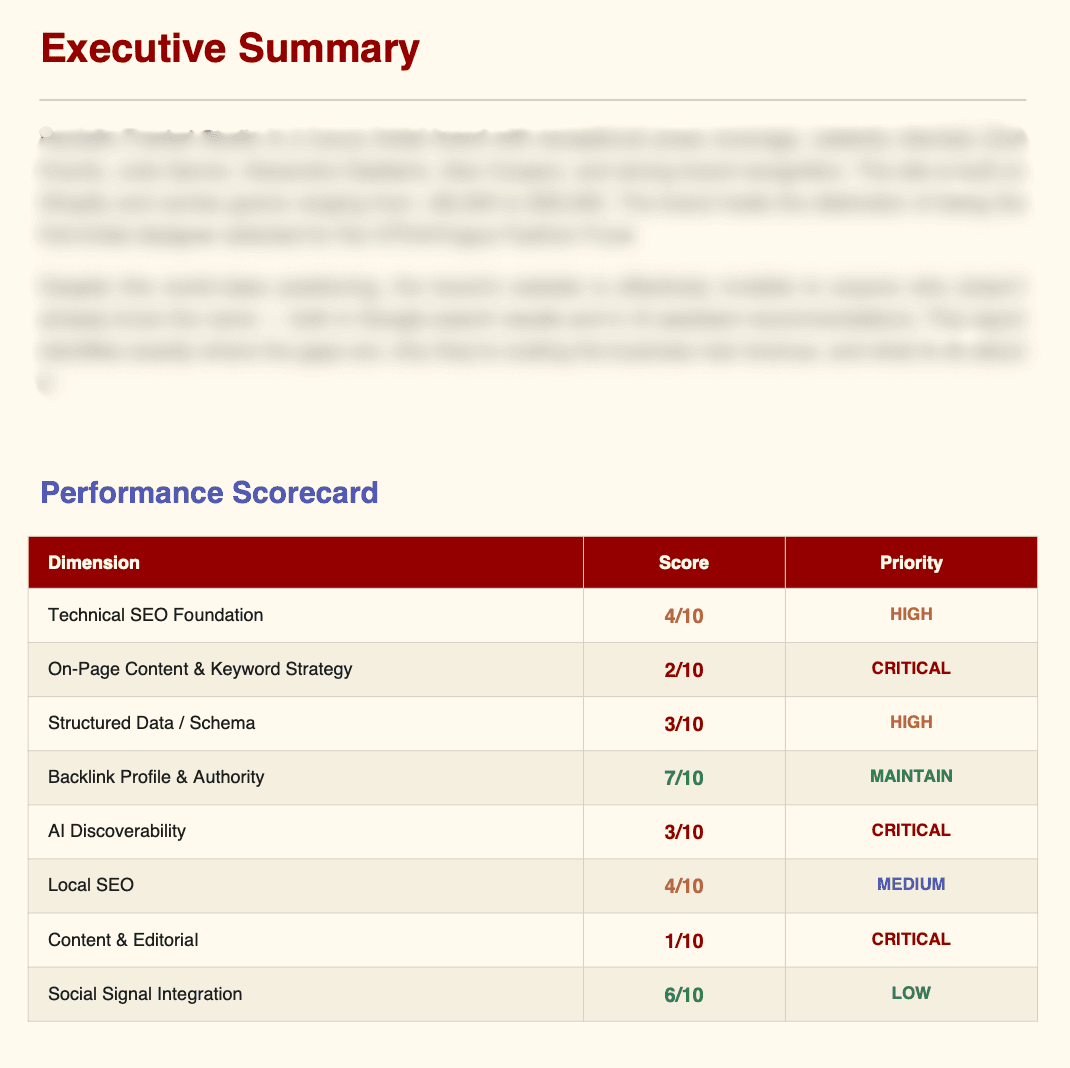
Request your full AI visibility report below and we’ll send the analysis and execution plan.
AEO is structuring your site and your wider web presence so AI answer engines (ChatGPT, Gemini, Claude, Perplexity, Copilot) can read it, resolve you as a specific business, and cite you by name when someone asks a buying question. In practice that means machine-readable JSON-LD schema, a consistent entity identity across the web, content written as direct answers, and AI-readable files like llms.txt. It builds on SEO rather than replacing it.
SEO competes for a ranked position on a results page. AEO competes to be the source an AI names inside its answer, where there is no page two. The fundamentals overlap (crawlable, fast, credible pages), but AEO adds three layers SEO does not prioritize: structured data depth and validity, entity consistency across directories and knowledge bases, and content formatted for extraction such as definitions, FAQs, and tables. It also adds measurement, because AI answers are non-deterministic and vary by model and run.
From what we observe across engines, citations favor businesses the model can resolve unambiguously and corroborate from more than one source. That means a clear, consistent identity (name, location, services) repeated across your site, your structured data, and third-party pages, plus content that answers the specific question directly. Each engine retrieves differently, some through live web search, some through a search index, some through a knowledge graph, so the work has to hold up across several systems rather than gaming one. We treat the exact weighting as observed, not confirmed.
On the page: valid JSON-LD (Organization, Service, FAQPage, Breadcrumb), entity consistency (matching name and sameAs links everywhere you appear), direct-answer content blocks, freshness signals, and AI-crawler access in robots.txt for GPTBot, ClaudeBot, PerplexityBot, and Google-Extended. Off the page: corroborating, consistent profiles on the sources engines retrieve from, including Google Business Profile, Wikipedia and Wikidata, Reddit, and LinkedIn. The on-site layer is the part you fully control, and it is what our 16-factor model scores.
It is unsettled, and we say so. Google has stated it does not use llms.txt. Across other crawlers and engines we have observed behavior consistent with these files being read, and the cost to publish them is near zero, so we keep them as a redundancy layer and frame their value as observed rather than proven. They are never a substitute for clean HTML, valid schema, and real content.
Primary focus is ChatGPT (OpenAI), Claude (Anthropic), Gemini (Google), Perplexity, and Copilot (Microsoft). We also track Grok, Meta AI, and DeepSeek, plus the off-site surfaces these engines pull from: Wikipedia and Wikidata, Reddit and Quora, LinkedIn, X, YouTube, Google Business Profile, news, and reviews. Because each behaves differently, we optimize for signals that hold across engines rather than one vendor playbook.
Two layers. First, log and analytics classification: separating AI crawler hits (GPTBot, ClaudeBot, and peers) and AI referral traffic from ordinary traffic. Second, repeated prompt sweeps: running your target questions against each engine on a schedule and recording, per phrase and per engine, whether you were cited, mentioned, or absent, and which competitors appeared. Because responses are non-deterministic, we read trends across many runs, not single answers.
No. Schema is one input. Strong AEO is four layers working together: SEO fundamentals, technical on-site signals (the 16-factor model), content depth and clarity, and off-site corroboration. A perfect schema score on a thin or inconsistent site will not earn citations.
Yes. Our audit engine is open source as @ainyc/aeo-audit on npm and GitHub, and the Canonry platform is open-source and self-hostable at app.canonry.ai, so you can run the scoring and citation monitoring yourself. The managed service exists for teams that would rather we run it for them.
It depends on your starting point, market, competition, and how volatile the prompts are. We do not promise a fixed timeline, because AI visibility can shift when models are updated or re-indexed, often without notice. We baseline first, then track movement per engine over time.
The website AEO audit is free, within fair-use limits. The full AI Visibility Report and done-for-you execution are paid; send your details and we scope a quote by email. The open-source tools are free to self-host.